Solana system
Build the graph. Keep one source of truth.
Solana turns a product goal into bounded work, lets compatible tasks move in parallel, protects shared resources, and accepts only what works in the integrated product.
one state writer
direct + graph lanes
acceptance before success
bounded workers
Goal-to-graph production entry verified · authority held268 modular · 239 moderator · kernel exception reviewed · legacy remains recoverable
Solana system map
One goal becomes the smallest safe path.
Sol proposes a bounded plan. Deterministic admission recalculates its structure, chooses the direct or graph lane, and lets only dependency-ready, resource-compatible Luna work move forward.
Current production-entry design
Architecture model · not live telemetry
Sol proposes
Sol/high returns only the typed lane, nodes, dependencies, ownership, artifacts, and decisions. It cannot launch workers or mutate state.
Code recalculates
Admission derives four signals from structure: material dependency, parallel ownership, scarce resource, and recovery need. A mismatch is rejected.
The lane is earned
Direct requires one dependency-free direct_fix and no graph signal. Any valid signal requires the graph lane.
The next wave is deterministic
Only ready nodes qualify. LongBuild sorts by downstream depth, then topological order, then node ID, and takes no more than the project's worker cap.
Luna workers per project
The request owns the cap. Dependencies and resource conflicts may make the running count lower.
Active projects maximum
Projects sharing a workspace serialize. Disjoint workspaces may run at the same time.
Theoretical aggregate
Three projects times three Luna workers. This is a code ceiling, not a safe recommendation for every machine.
No machine-pressure gate yet
The current runtime does not lower dispatch from CPU, RAM, swap, thermal state, provider quota, or integration backlog. Named leases prevent collisions, not exhaustion.
How deployment works now
An accepted frozen commit verifies and packages first. Exact standing authority chooses production, an authorized preview fallback, or artifact-only output. Deployment holds an exclusive target lease and must prove rollback; live system usage does not choose the release mode.
Interactive graph lab
See what may run—and why.
Switch between a direct fix, a visual-foundation decision, the accepted long-build system, and current Phase 5 transition truth, or connect this studio read-only to a running vNext project. Select any node to inspect its dependencies, mode, and resource claims—including the admitted production graph.
Tap a node · advance one deterministic event at a time
Waiting
Ready
Running
Accepted
Rejected / blocked
Active resource claims
Only running nodes hold live write or physical-resource leases.
No active leases
Scenario playback. The examples are deterministic simulations; use the live connector above for runtime state.
Binding model split
Sol writes the packet. Luna ships the slice.
Sol plans every change and keeps splitting until one Luna xhigh worker can complete one meaningful outcome without inventing architecture or wandering into adjacent work.
gpt-5.6-sol · high
Plan + decompose
Interprets the goal, freezes decisions, builds the graph, and writes exact implementation packets.
- No product-code writes
- No scheduling or state ownership
- Replans only affected nodes
Luna packet
800–2,000 structured words
gpt-5.6-luna · xhigh
Implement + return
Changes only the owned surface, runs offline worker checks, and returns unstaged work with hashed evidence. The trusted controller seals the commit.
- One observable outcome
- One primary write domain
- Stop instead of widening scope
tests + fresh Sol review
Accept independently
Deterministic checks run first; a fresh read-only Sol context judges contract, code, visual, and integrated product fit.
Luna fit gate
A task launches only when all six lights are green.
One sentence names the behavior that becomes true.
One feature, foundation, interface, or schema owner.
Base commit, contract, foundation, and dependencies are fixed.
One bounded attempt; uncertainty or larger work returns to Sol.
Offline worker commands plus trusted host-only verification.
No adjacent cleanup, redesign, refactor, or scope expansion.
Descriptive without becoming huge
Structure beats a giant prompt.
Luna gets current behavior, desired behavior, pinned inputs, exact ownership, a required sequence, non-goals, checks, evidence, and stop codes. It does not receive the entire repo history.
call_splitTwo independent outcomes → split
call_splitTwo write domains → split
undoUnresolved decision → back to Sol
stop_circleScope drift → stop, don't improvise
identity: luna-ui-017
outcome: caregiver card opens the real timeline
base: 91f2c6 · foundation: helios-v4
writes: feature:person-home
allowed: src/features/person-home/**
must:
  - preserve the approved card anatomy
  - route to /people/:id/timeline
  - expose loading and empty states
must_not:
  - change navigation or shared tokens
  - add a live-pulse control
accept:
  worker: focused behavior test
  trusted: 402px running-product capture
stop: contract_gap | needs_split | dependency_stale
Long-task operating horizon
Keep the destination. Reveal the next terrain.
A giant product is never flattened into one prompt. The complete outcome stays durable while only the next one or two integration milestones become a fully executable graph.
Phase 4 · live canary 01 · accepted slice
The controller now survives real product work.
One real Sol/high call sealed backend and UI milestones. After the backend integrated, the controller was forcibly reopened; it made zero planning or backend calls and advanced only the newly ready caregiver home through Chrome, fresh Sol review, and exact integration.
1,107.973slive run
2exact commits
0replay calls
Open live audit
Phase 4 · live canary 02 · accepted slice
Parallel build. One recoverable promotion.
Two Luna/xhigh workers started 20 ms apart on disjoint same-base modules while the queue stayed empty. Their sealed results entered one durable epoch, passed the combined system once, and replayed after a forced post-promotion SQLite reopen with zero model calls.
80.187sreal overlap
1.630×worker speedup
0replay calls
Open batch audit
Phase 4 · live canary 03 · accepted slice
The long-build loop chooses the wave itself.
LongBuild sent two ready nodes through the same recipe modules and graph runner, deferred only their integration claims, and recovered the promoted epoch before any planner or worker could run again.
99.724sreal overlap
1.897×worker speedup
0replay calls
Open automatic-wave audit
Phase 4 · combined system canary · gate accepted
Two horizons finish without waking the operator.
Three Luna/xhigh tasks and one Sol/high renewal crossed a forced post-promotion restart. Five exact verification replays hit trusted cache evidence, zero model calls repeated after reopen, and two accepted milestones compacted into one terminal graph node.
104.187sreal overlap
1.893×worker speedup
5/5exact cache hits
Open system audit
Unattended by contract
One request in.
A finished product out.
No mid-build taste votes, architecture questions, decomposition approvals, or visual checkpoints. Ordinary uncertainty is work for Sol to research and resolve—not a reason to wake the operator.
Research the unknown
Record a reversible assumption and continue.
Select the foundation
Fresh Sol review chooses from running code against the contract.
Build through proof
Luna implements; checks, acceptance, and integration continue automatically.
Deliver, then revise
Later feedback creates a new goal; it never blocks the first delivery.
Standing policy preauthorizes ordinary build and deploy actions. Missing external authority produces the safest useful fallback—not an idle approval queue.
Outcome horizon
months
The complete product
Users, non-goals, release boundary, and final proof survive for the entire build.
Architecture horizon
milestones
Stable subsystem map
Interfaces, ownership, dependency direction, and security boundaries prevent local drift.
Integration horizon
days
The next 1–2 milestones
Only near work is fully graphed, resource-checked, and acceptance-ready.
Execution horizon
minutes
One Luna packet
One outcome, one write domain, exact checks, and a 20–60 minute attempt.
My speed contract
Optimize accepted wall time—not agent activity.
Run the ready task that unlocks the most downstream work.
Accept high-fan-out schemas and foundations before feature fan-out.
Reuse clean environments, dependencies, compiler output, and code maps.
Test the leaf now; pay the full-system cost only at named boundaries.
LongBuild saved 99.724 seconds on its live pair, verified one union, and promoted once.
Add workers only while ready domains, resources, and integration can absorb them.
Example product horizon
A browser becomes a chain of running products.
This is software the system could be asked to build—not its worker browser tool. Start with a real shell on a pinned WebKit or Chromium engine, or explicitly scope a new engine as a portfolio of subsystem programs.
- 01Shell + navigationload · back · forward · reload · visible failure
- 02Tabs + recoverywindows · sessions · forced restart · exact resume
- 03User datahistory · bookmarks · downloads · permissions
- 04Security + releaseprivacy · sandbox · updates · rollback · accessibility
- 05Engine ownership, laternetwork · parser · JS · layout · paint · media
Separate tooling boundary
Workers initially share one brokered BrowserHarness session backed by one Playwright adapter. The browser above is the enormous product example, not that testing resource.
Remove from the fast path
whole-project detailed plans
full suites per leaf
review every trivial node
default candidate tournaments
repo-dump prompts
handoff-only agents
Small control plane
Modular capabilities. One boring authority.
Agents supply judgment and implementation. Deterministic code owns state, permissions, resources, acceptance, and integration.
ProjectController
The only execution-state writer. Reacts to events instead of racing multiple polling loops.
deterministic kernelWorkGraph
Tracks dependencies, artifact versions, readiness, invalidation, and milestone epochs.
DAG + lineageResourceBroker
Grants compatible read, write, and physical-resource leases with fairness and expiry.
collision controlResultAcceptor
Separates a worker process exiting from the integrated product actually being accepted.
truth boundaryIntegrationQueue
Claims one result or durable compatible epoch, verifies the exact union, and moves authority once.
ordered promotion01
Direct lane
Preserves context and speed when decomposition would cost more than it saves.
ContractImplementVerifyMerge
- Bug fixes and contained UI changes
- One owner, one bounded result
- Same acceptance and integration contracts
02
Graph lane
Earns its overhead when work is parallel, long-lived, resource-bound, or failure-prone.
- Whole products and multi-day builds
- Compatible work moves in parallel
- Only affected dependents are invalidated
Anti-overengineering constitution
Every new mechanism must earn its weight.
Solana has explicit ceilings so a useful kernel cannot quietly regrow into a platform of competing schedulers, stages, supervisors, evidence generators, and retry paths.
Read the binding rulesNo graph database
SQLite nodes, edges, events, leases, and versions are enough until measured scale proves otherwise.
No arbitrary workflow DSL
Six tested recipes beat an agent inventing a new lifecycle for every request.
No supervisor stack
One controller, one slow safety sweep, and explicit provider-process cleanup.
No unused evidence
Every artifact names a consumer; unconsumed output is waste, not progress.
Deletion accompanies addition
Every mechanism proposal identifies the failure it prevents and what it replaces or removes.
Product proof wins
Integrated behavioral and visual evidence outranks process receipts and screenshot quantity.
Source shape is a navigation budget
Files average 200–400 logical lines within a module. Crossing 500 triggers a cohesion review—not blind rejection or tiny-file theater.
Shared product-design standard
Wobbleby confidence. Product-owned identity.
Reuse the craft: neutral sans typography, purposeful radii, disciplined color, real interactions, flat original graphics, and running-code review. Never copy Wobbleby's palette, mascot, content, or layout.
Product design contract
Rounded with purpose, never rounded by habit.
Shape, space, color, and depth communicate hierarchy before decoration.
Foundation v7
Content card24pxoutline by default
Input18px
Chip · 12px
Typography
- Inter-style neutral sans for UI
- Inter Tight only for display
- Sentence case for every UI phrase
- Uppercase only for real acronyms
Canvas + color
- True white or deliberate dark fields
- One dominant hue per screen
- No beige or pastel full canvas
- Gray provides hierarchy, not brand
Shape + depth
- 8 / 12 / 18 / 24 / 32 radius ladder
- Beautiful 1px outlines by default
- Shadows only for floating surfaces
- No pill or card repeated everywhere
Controls
- 44px minimum target
- One primary action per viewport
- Every enabled control really works
- No decorative live-pulse button
Graphics + motion
- Original flat 2D or code-native art
- No glossy AI spheres or fake glass
- Motion settles in about 160–320ms
- Reduced motion always supported
Acceptance
- Judge real running screens
- Test phone through wide desktop
- No document overflow or clipping
- Screenshot counts never prove beauty
Never by default
cream canvas
pastel soup
all-caps labels
fancy serif UI
generic gradients
card-stack sameness
decorative pulse
Running-product evidence
Pixels, structure, and behavior agree.
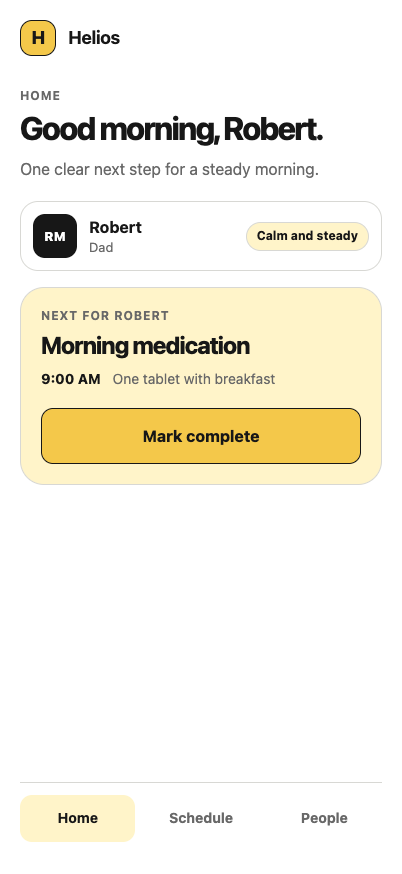
These are the exact accepted 402×874 Chrome captures—not mockups. The gate checks mounted regions, real interaction, fonts, console health, overflow, pixel hashes, and fresh read-only Sol judgment.
Browse earlier gate proofs4 concise records
Production entry · current revision
One API goal became a direct lane and two real graphs.
In 783.879 seconds the isolated `/vnext` runtime completed a direct fix, a compatible backend wave, and a dependency-ordered Helios foundation/home build. Every result integrated cleanly; the UI graph passed real Chrome capture and fresh Sol review with no operator checkpoint.
P1
Helios foundationproduction graph · accepted
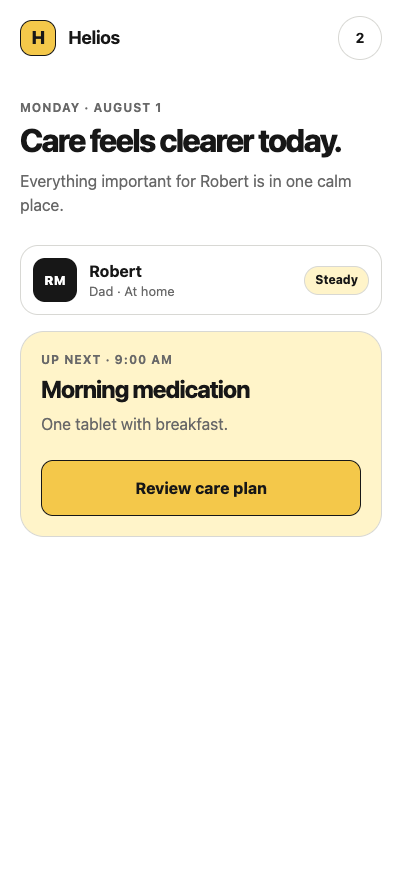
P2
Caregiver homepending · accepted
P3
Completed actionreal click · stable shell
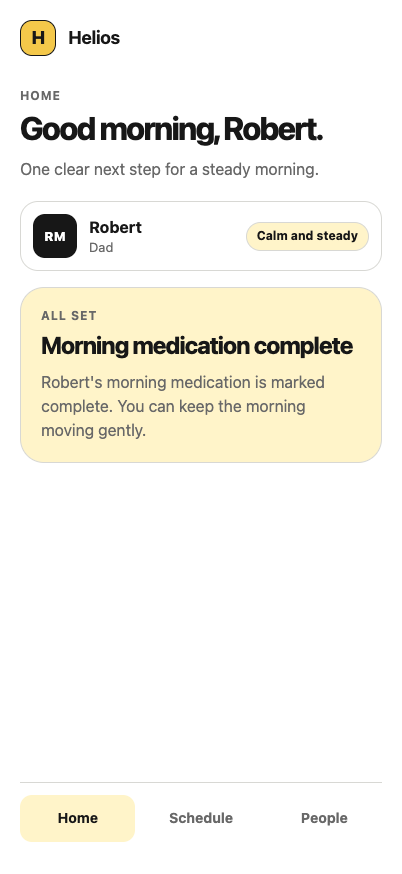
Goal-to-graph production entry 01 · acceptedTyped Sol planning, deterministic admission, direct/backend/UI execution, exact Git authority, and running-product proof pass together.
Open production-entry audit
Earlier vertical-slice proof
The product contract was earned before production intake.
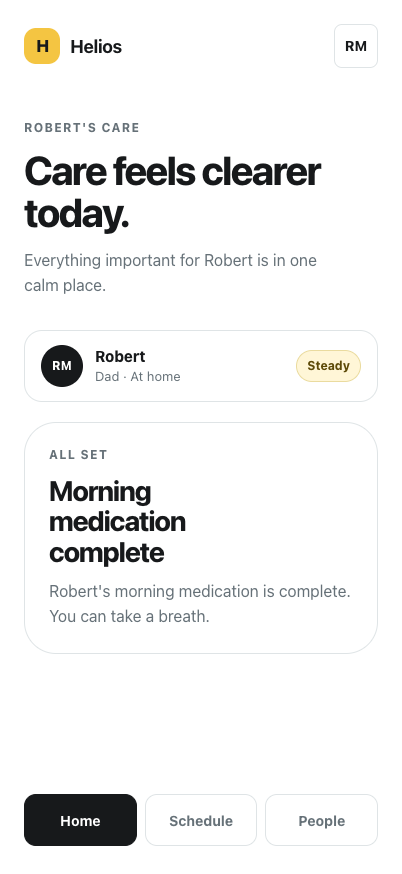
These Phase 3 captures remain immutable history: the first integrated Helios foundation and caregiver interaction that established the visual acceptance boundary later consumed by production entry.
01
Foundationaccepted · immutable capture
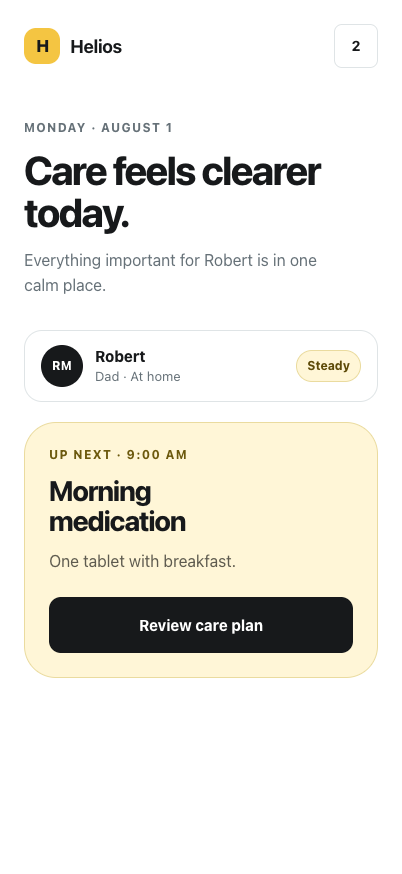
02
Caregiver homeinitial state · accepted
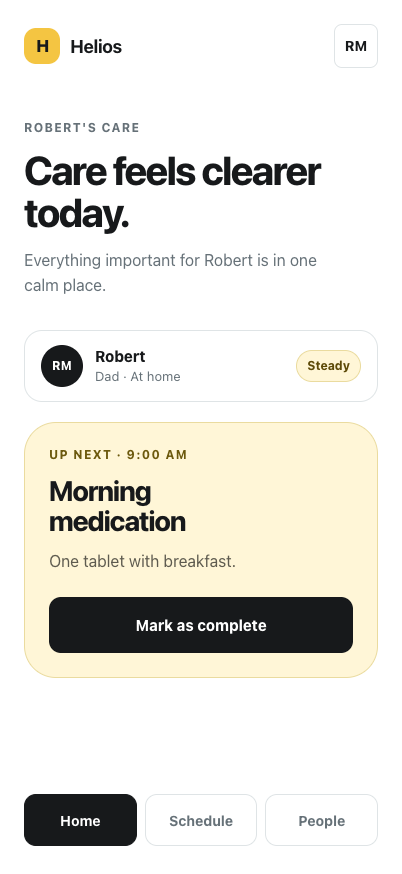
03
Completed actionreal click · stable shell
Autonomous foundation decision
Two running directions. One authoritative winner.
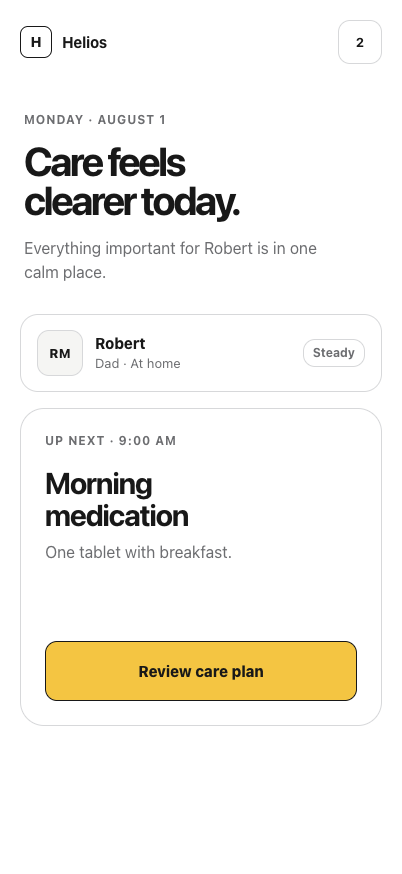
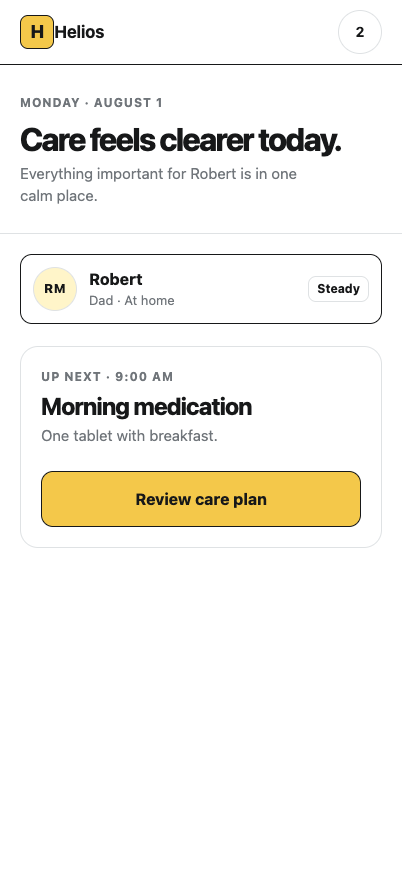
Both Luna candidates began from the same base and implemented concurrently. One Chrome resource captured them in order; fresh Sol selected Airy editorial, and only that commit entered the integration queue.
04
Airy editorialselected · integrated
05
Structured utilityvalid candidate · not integrated
Phase 3 · accepted · gate 4/4Backend, cooperative UI, read-only lineage, and competitive UI all pass.
Open consolidated gate
Phase 4 · live long-build resume
Backend accepted. Controller reopened. UI continued.
One real Sol horizon produced two milestones. After the first exact integration, SQLite reopened with a forbidden planner; only the caregiver home ran, and both exported states passed a preserved fresh Sol review.
06
Long-build homeAPI-backed · integrated
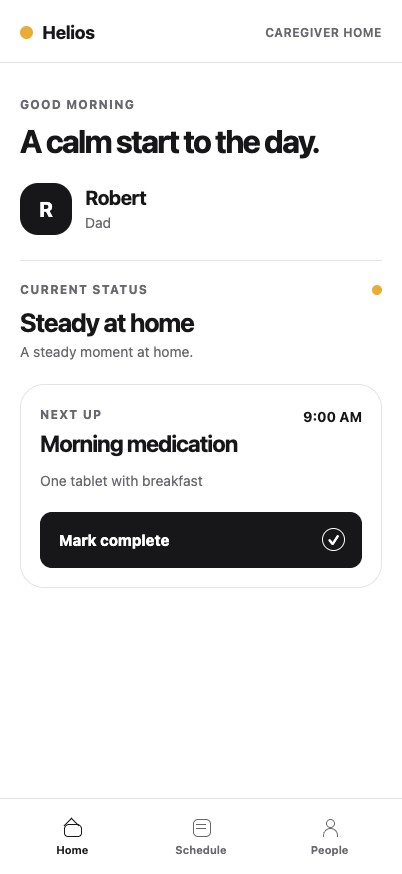
07
Completed statereal click · shell retained
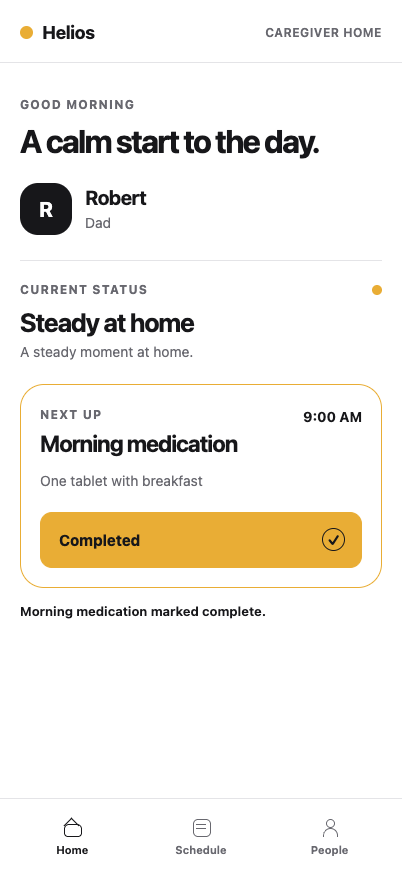
Phase 5 · matched evidence acceptedModular won direct and complex work, finished complex work 224.475 seconds faster, and left legacy authority untouched.
Open Phase 5 gate
Production entry · direct + graph verifiedTyped Sol plans now enter the existing direct or graph executor; the current canary completed direct, backend, and UI work while the selector stayed on legacy.
Open current production-entry audit
Phase 4 · live slice acceptedOne horizon call, forced reopen, zero replay, two exact commits, and accepted running pixels.
Open live audit
Phase 4 · compatible batch acceptedTwo real Luna workers, 80.187 seconds overlap, zero queue claims during build, one union, one promotion, exact crash replay.
Open batch audit
Phase 4 · automatic wave acceptedLongBuild itself started two real Luna workers, deferred both claims, promoted one epoch, and recovered with zero replay.
Open automatic-wave audit
Phase 4 · long-build gate acceptedRenewal, compaction, cache, forced recovery, and terminal system proof now pass together.
Open consolidated gate
Terminal audit · one external authority boundary remains
The exact release is ready; transition remains explicit
Build, evidence, publication, budget, source, selector health, launchd target, rollback bundle, clean Git commit, and portable candidate pass. Authorization to activate the selected service and exercise automatic direct/graph fail-back is the only remaining gate.
Open current terminal auditTransition prep 01 · rollback source pinned
Both selector values boot; no production value changed
A 212-entry local source snapshot pins the exact runtime bytes, legacy and modular safe-mode health pass through one entrypoint, and separate database names make fail-back non-migratory. The archive stays local rather than being published here.
Open transition runbookTransition target 01 · discovered read-only
The exact service and rollback bundle are no longer guesses
Launchd service com.nyx.moderator, plist, portable launcher, health port, state root, bootout/bootstrap behavior, and the verified legacy bundle are pinned. The job is currently unloaded, port 8787 is closed, and no production value changed.
Scoped release 01 · accepted locally
The dirty checkout is no longer a release blocker
Clean commit c10d9f6b…, 282 byte-matched source files, complete Git bundle, Node 22 portable archive, native SQLite, and explicit legacy/modular health pass. The candidate remains local and inactive.
Kernel budget review 01 · accepted exception
The 592-line overage is measured, bounded, and temporary
Five cohesive production-entry responsibilities close demonstrated failures without adding another writer, scheduler, broker, retry owner, queue, process, or recipe. The exception expires before Phase 6 or any new kernel mechanism.
Open kernel reviewGoal-to-graph entry 01 · accepted
The production boundary now admits real direct and graph work
268 modular and 239 moderator tests support one unattended 783.879-second canary spanning direct, parallel backend, and dependency-ordered UI work with immutable running-product evidence.
Open goal-to-graph evidenceProduction front door 01 · historical direct slice
The tested engine gained its process and API boundary here
This earlier milestone established native and CLI intake, Git lineage, safe/full reopen, unique attempts, workspace serialization, shutdown, network boot, and the inactive selector.
Open front-door evidencePhase 5 · complex shadow 02 · modular wins
Two horizons finished in 51.94% of legacy time
Three Luna tasks, one Sol renewal, two deterministic promotions, four passing integrated checks, equal total model calls, zero retries, and zero orphans.
Open complex comparisonPhase 5 · direct shadow 01 · modular wins
Direct work stays lean and reaches authority
The modular lane accepted with two calls in 259.372 seconds. Legacy used two calls but its model-owned integration could not write Git metadata.
Open direct comparisonPhase 5 · release canary · accepted
Frozen release and rollback survive controller loss
Three exact verification domains, deterministic packaging, standing-policy publication, exercised rollback, zero stage replay, and a clean newer Git head.
Open release auditPhase 4 · combined system canary · accepted
The long build completed through its second horizon
Completed in 270.316s with three Luna tasks, one Sol renewal, 104.187 seconds of overlap, 5/5 exact cache hits, zero model replay after restart, and one terminal compacted graph.
Open the combined auditPhase 4 · deterministic mechanisms · accepted
History shrinks without losing truth
Content-addressed summaries preserve lineage, horizon renewal admits only the next exact prefix, and trusted verification cache entries cannot cross a changed tree, command, environment, or policy.
Open the mechanism auditPhase 4 · live canary 03 · accepted
The long-build controller now consumes the batch seam
Two real Luna/xhigh workers overlapped for 99.724 seconds through the normal graph runner, then one promoted epoch survived forced reopen with zero model replay.
Open the automatic-wave auditPhase 4 · live canary 02 · accepted
Parallel workers now earn one integration epoch
Two real Luna/xhigh workers overlapped, the queue stayed free during implementation, combined checks ran once, and post-promotion reopen replayed with zero model calls.
Open the batch auditPhase 4 · live canary 01 · accepted
Accepted backend work survives a real reopen
Sol planned two milestones once. Backend integrated, SQLite reopened, only UI continued, and two running states reached exact authority.
Open the live auditCooperative canary 03 · accepted
Only the evidence that survived every layer
Two exact commits, three captures, two independent judgments, and a clean integration head.
Open the complete auditCompetitive canary 01 · accepted
The loser never touched authority
Two overlapping Luna builds, serialized Chrome, one fresh Sol decision, and exactly one winner-only integration.
Open the competition auditCanary 01 · revoked
A green model verdict was not enough
Opening the pixels exposed a missing shell. The false positive became a new deterministic viewport gate.
Read the revocationCanary 02 · rejected
Both repair attempts stopped safely
The completed viewport lost primary navigation, so no home candidate integrated and no evidence was promoted.
Read the rejectionBuild order
Prove one loop before expanding the system.
Each phase ends in observable behavior and a hard gate—not another architecture layer.
Accepted · foundation
Authority and contracts are pinned
Clean source, legacy evidence, autonomy policy, model routes, packets, results, and exact event fixture are accepted.
Accepted · direct golden loop · 5/5 canaries
Direct work survives reality
Single-file replay, exact multi-file and new-file ownership, evidence-guided clean retry, and controller-reopen worker recovery all pass with real Sol and Luna.
Accepted · graph + resources · gate 4/4
Compatible work runs safely
Persisted DAG lineage, fair recoverable leases, exact ordered integration, two-project overlap, writer serialization, and real process-family isolation all pass.
Accepted · backend + UI modules · gate 4/4
Real product modules reach authority safely
Backend, cooperative UI, read-only lineage, and autonomous two-direction selection pass with current-revision live evidence.
Accepted · long build · system gate
Long work survives interruption and renewal
Automatic waves, exact crash recovery, 5/5 cache replay, bounded Sol renewal, replay-safe compaction, and the combined live system review all pass.
Scoped release + rollback verified · external authority pending
Transition one selector, reversibly
Direct and graph entry, source, selector boots, launchd target, rollback bundle, clean commit, and portable candidate pass. The service is currently unloaded; only explicit switch permission and the live fail-back exercise remain.
Hermes · later
Add conversation after stable control
Versioned read-only explanation first, then signed policy-checked commands—never a second orchestrator.
Future interface · deliberately later
Talk to Hermes. Let the builder do the work.
Hermes becomes the conversational operator after the builder has a stable command and query API. It explains and issues already-authorized requests under standing policy. It never becomes a second state owner or coding runtime.
YouHermesBuilderWorkers
- Read-only project explanation ships first.
- Mutating commands are signed and policy checked.
- Hermes never edits, accepts, locks, or merges code.
Ask about the project…
The operating thesis
Ambitious outcomes.
Smaller mechanisms.
Solana keeps the part of Nyx that behaved like dependable infrastructure and replaces the part that confused activity with a finished product.